


The Modern Marriage Blueprint: Why Prenups Are Having a Mainstream Moment
There was a time when bringing up a prenuptial agreement during an engagement felt like the ultimate romance killer. It conjured images of high-profile Hollywood divorces or ultra-wealthy families protecting generational fortunes.
Today, it's quickly becoming a standard item on the wedding checklist.
A shifting economic landscape, changing career dynamics, and a growing sense of financial pragmatism have pushed prenups into the mainstream. Rather than signaling a lack of trust, many modern couples now see a prenuptial agreement as a transparent financial blueprint for building a future together.
The Rising Trend: Marriage Meets Pragmatism
According to 2026 data from The Harris Poll, attitudes toward prenuptial agreements have changed dramatically. An estimated 53% of engaged or married Americans under age 45 have signed a prenup.
To put that into perspective:
- 1990s: 8%
- 2022: 34%
- 2026: 53%
So what's driving this cultural shift? Two major factors stand out: people are marrying later in life, and prenups are no longer viewed as something reserved for the ultra-wealthy.
Marrying Later, Building More
The average age of first marriage has steadily increased for decades. By the time many couples marry—often around age 30 or later—both partners have spent years building independent financial lives.
That may include:
- Retirement accounts
- Investment portfolios
- Home equity
- Business interests
- Student loan debt
- Other financial obligations
With meaningful assets and liabilities already established, conversations about financial expectations become both practical and necessary.
Not Just for Millionaires
Today's prenups extend far beyond protecting inherited wealth.
Many couples use them to:
- Clarify how household expenses will be shared.
- Protect one spouse from the other's pre-existing debt.
- Define ownership of businesses or future entrepreneurial ventures.
- Address intellectual property or other unique assets.
In many cases, a prenup serves as a framework for financial communication rather than simply a legal safeguard.
The Breadwinner Shift: Changing Financial Dynamics
Another significant driver behind the rise of prenups is the changing financial relationship between spouses.
Data from the American Community Survey, compiled through IPUMS (Integrated Public Use Microdata Series), shows the spousal income gap continuing to narrow.
- In 2011, recently married women earned approximately 68% of their husband's median income.
- By the mid-2020s, that figure had risen to approximately 80%.
- Among never-married young adults who are out of school, median earnings between men and women are now nearly equal.
As women increasingly enter marriage with equal—or even greater—earning power, conversations about financial independence and asset protection have naturally evolved.
According to internal data from HelloPrenup, women now initiate 52% of all prenuptial agreements created through the platform. Broader legal trends similarly show women requesting nearly half of all prenups nationwide.
Whether they're protecting an independently built career, safeguarding a business, preserving personal assets, or planning for future caregiving responsibilities, many women are taking an active role in structuring their family's financial future.
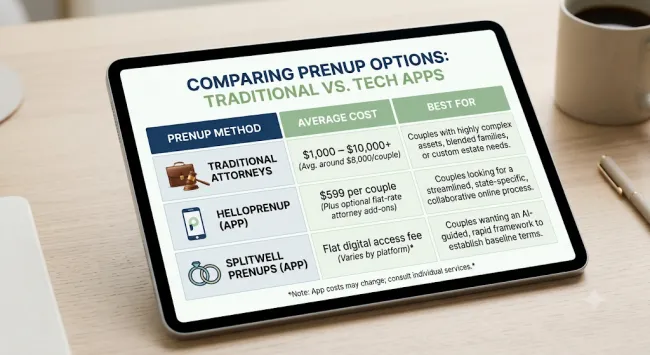
What Does a Prenup Cost? (Traditional vs. Tech)
Historically, cost has been one of the biggest barriers to creating a prenuptial agreement.
Working with separate family law attorneys to draft, negotiate, and finalize a custom agreement often requires weeks of work and can cost several thousand dollars.
Today, legal technology has made the process significantly more accessible.
Modern digital platforms streamline much of the experience through guided questionnaires and collaborative software, helping many couples create agreements more efficiently and at a lower cost than the traditional attorney-only process.
The Takeaway
Talking openly about money isn't unromantic—it's foundational.
A prenup encourages couples to have honest conversations about financial goals, spending habits, debt, future plans, and expectations before saying, "I do."
Rather than anticipating failure, many modern couples view a prenuptial agreement as a planning tool that helps both partners begin their marriage with greater transparency, clarity, and confidence.
Sources & References
- The Harris Poll. Prenuptial Agreements and Young Americans Survey Trend Report (2026). (Data documenting the increase to 53% of engaged or married Americans under age 45 signing prenuptial agreements.)
- IPUMS USA (Integrated Public Use Microdata Series). American Community Survey (ACS) Microdata, 2011–2024. Minnesota Population Center, University of Minnesota. https://usa.ipums.org (Data supporting trends in the narrowing spousal income gap and changing earnings dynamics.)
- HelloPrenup. Annual Marital FinTech & User Demographics Data Release. (Platform data indicating women initiate approximately 52% of digital prenuptial agreements.)
- Institute for Family Studies (IFS). Marriage Demographics, Asset Accumulation, and Age Trends. https://ifstudies.org (Supporting information on rising age at first marriage and financial asset accumulation.)
- American Bar Association (ABA), Section of Family Law. National Client Fee Survey and Legal Tech Cost Benchmarks. (Reference for traditional attorney costs and comparisons with modern legal technology solutions.)
The information on this site is not intended as tax, accounting or legal advice, as an offer or solicitation of an offer to buy or sell, or as an endorsement of any company, security, fund, or other securities or non-securities offering. This information should not be relied upon as the sole factor in an investment making decision. Past performance is no indication of future results. Investment in securities involves significant risk and has the potential for partial or complete loss of funds invested. It should not be assumed that any recommendations made will be profitable or equal any performance noted on this site. The information on this site is provided “AS IS” and without warranties of any kind either express or implied. To the fullest extent permissible pursuant to applicable laws, Vidarrow Investment Advisors disclaims all warranties, express or implied, including, but not limited to, implied warranties of merchantability, non-infringement, and suitability for a particular purpose. Vidarrow does not warrant that the information on this site will be free from error. Your use of the information is at your sole risk. Under no circumstances shall Vidarrow be liable for any direct, indirect, special or consequential damages that result from the use of, or the inability to use, the information provided on this site, even if Vidarrow or a Vidarrow authorized representative has been advised of the possibility of such damages. Information contained on this site should not be considered a solicitation to buy, an offer to sell, or a recommendation of any security in any jurisdiction where such offer, solicitation, or recommendation would be unlawful or unauthorized